

The passing of the Myanmar Investment Law 40/2016 (MIL) has brought about significant changes to Myanmar’s investment framework affecting both Myanmar and foreign investors. With the MIL affecting all investments in Myanmar, no matter how large or small, or whether being made by local or foreign investors, it is important to have an understanding how the MIL affects your investment.
SCM Lgeal were engaged by the International Finance Corporation to assist the Directorate of Investment and Company Administration in drafting the Myanmar Investment Rules which were prepared to implement the MIL. If you have any questions on how the MIL may affect you and your business, please contact us.
Key points for investors to consider:
Previous investment laws in Myanmar were only applicable to Myanmar investors if they decided to obtain an investment approval from the Myanmar Investment Commission (MIC), encouraged to do so in order to obtain tax incentives and, in the case of foreign investors, the right to invest in the designated restricted sectors, obtain tax incentives and rights to long term leases of land. MIC would review the investments to decide whether the investments were beneficial for the development of Myanmar. Separate regimes regulated foreign and local investments.
An important distinction of the new MIL is that it applies to all investments, no longer giving investors the option to decide whether they want to invest under Myanmar’s investment laws or whether they want to remain outside of the framework. This creates a level playing field for investors in Myanmar allowing all investors to take advantage of the benefits and protections available under the MIL.
Previously, obtaining an investment approval was almost always linked with obtaining income tax exemptions and other tax incentives. This was one of the reasons why a Permit would usually only be given to sizeable investments with a considerable economic benefit. The MIL has decoupled tax incentives from obtaining an investment approval, allowing it to target specific priority sectors with tax incentives while still allowing other investors to enjoy the non- tax benefits available under the MIL.
An important feature of the MIL is the formation of State and Regional Investment Committees. With the exception of Permit applications or Tax Incentives applications, a State and Regional Investment Committee may approve and receive submissions for investments with a value up to USD5 million or MMK6 billion. For the purpose of this overview we only refer to the MIC, however subject to restrictions this role can be carried out by the relevant State and Regional Investment Committee.
Part 1 examines issues relevant to investors looking at making an investment in Myanmar and how they are affected by the MIL. Any reference to the MIL includes references to provisions under the Myanmar Investment Rules which implement the MIL.
1.1 Investors and Investments
Which investors are covered
The MIL applies to all investors whether local or foreign, big or small. Investors are defined to include natural persons, companies incorporated in Myanmar, foreign companies with a registered branch in Myanmar, any other kind of enterprise established under the Myanmar Companies Law or an entity established in accordance with the laws of any other country.
Which investments are covered
Investments covered by the MIL are much broader than just the construction of big projects, but includes investments in companies, equipment and other moveable property, shares, intellectual property rights, contractual rights and assignable rights. Most commercial transactions would be considered investments under the MIL.
1.2 Restrictions on investments
Before making an investment an investor should determine whether their investment is prohibited or otherwise restricted. Myanmar has adopted a negative list approach to restrictions, if investments are not included on the list they are open for investment. This may be subject however to restrictions under other applicable laws.
Prohibited investments
The MIL classifies types of investments which are prohibited by virtue of the environmental, health and cultural impacts they may have. The MIC has separately published a list of List of Restricted Business Activities (notification 15/2017), which lists specific businesses which are only to be carried out by the Government. The Government may however enter into agreements allowing non-government entities to carry out these activities.
Prohibited for foreign investment
The List of Restricted Business Activities includes a list of businesses which foreign investors may not operate. Examples include the operation of minimarts and convenience stores with a floor space of less than 10,000 square feet, tour guide services and small and medium scale mining.
Under the MIL, the term Foreign Investor includes foreign companies, branch offices and other enterprises established and registered in accordance with the Companies Law and enterprises formed under the laws of other countries. Under the previous Myanmar Companies Act a company is considered a Myanmar company only if it has 100% Myanmar ownership. This has change, since the new Myanmar Companies Law was enacted, the new law has allowed up to 35% foreign ownership in a Myanmar company before it is considered a foreign owned company. This has allowed businesses operating in a restricted business to have a minority foreign shareholder.
Joint venture investments
The List of Restricted Business Activities specifies businesses in which foreign investors may invest only as part of a joint venture with a Myanmar investor. Examples include manufacture of alcoholic beverages, food processing, manufacturing and wholesale of cosmetic products and apartment and condominium development.
For any joint venture specified on the restricted list, the minimum Myanmar investment, unless specified otherwise, is 20%. Indirect ownership of a foreign investor in a Myanmar investor is not considered when determining the Myanmar ownership percentage (for example, in Myanmar Companies Law, a foreign investor could acquire up to a 35% interest in the Myanmar joint venture partner in addition to holding 80% in the joint venture).
Investments requiring ministry approval
The final list of restricted investments includes businesses which require approval from the relevant Ministry. Ministries may include their own conditions which must be met prior to issuing such an approval. This may include further restricting foreign investment or requiring the investor to go through a separate licencing or permitting process.
For example, additional Ministry approval is required for businesses operating in retail, wholesale, telecommunication, grid connected power projects or power projects with a generating capacity of more than 30 MW. It should be noted that this requirement to obtain ministerial approval applies to both local and foreign investors.
Notice of a restricted investment
An investor making a restricted investment shall notify the MIC within 3 months of the commencement of implementation of the investment. This does not apply to investments for which a Permit or an Endorsement (see 1.3 below) is being applied for.
Investment Screening
If the investor is unsure whether their investment falls under any of the restricted categories, or whether a Permit may be required, they may submit and Investment Screening Application. MIC will issue non-binding guidance on whether the investment is subject to any restrictions under the MIL. We would recommend taking advantage of this process.
1.3 Investment approvals
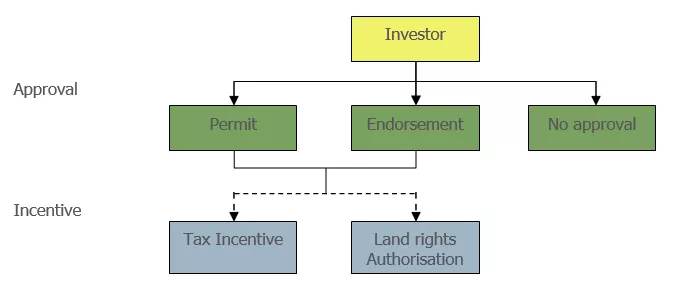
Whether an investment approval is required and what kind of approval will depend on the type of investment and on which incentives are sought.
Permit
A permit from the MIC approving the investment (Permit) is required where an investment meet certain criteria. These include:
Only investments which meet these criteria are required to apply for a Permit. When applying for a Permit the investor may also apply for Tax Incentives and a Land Rights Authorisation (see below).
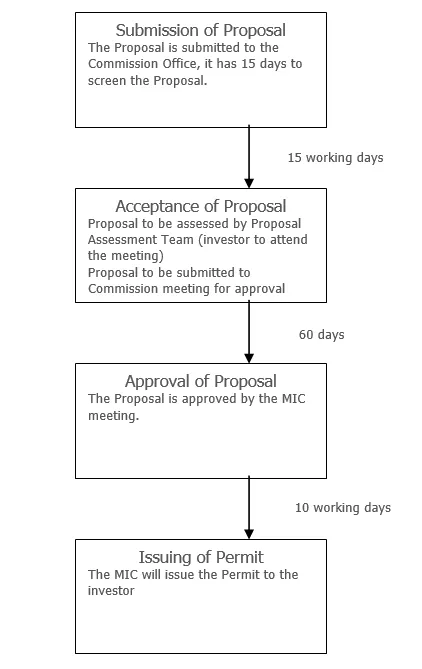
The application process requires the submission of a Proposal which includes details on the location, amount to be invested, forecast financial performance and employment opportunities. Presentations on the investment will need to be made to the Proposal Assessment Team and the MIC where the investor needs to be prepared to answer questions on the investment.
Endorsement
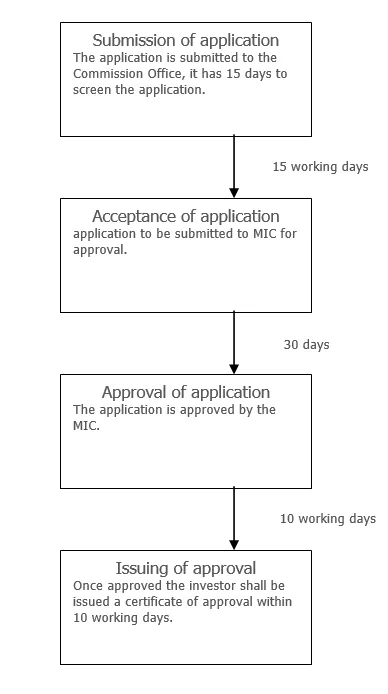
If the investment does not require a Permit, but the investor still wants to take advantage of a Tax Incentive and/or a Land Rights Authorisation, the investor will need to apply for an Endorsement. Obtaining an Endorsement is a much simpler procedure akin to registering the investment with the MIC. The Endorsement shall be issued within 15 working days of submitting the application.
No approval
If no Permit is required and the investor does not wish to apply for a Tax Incentive or a Land Rights Authorisation, the investor does not need to apply for any approval. Even with no approval the investment will be regulated by the MIL.
The diagram below shows the various approval options available to an investor under the MIL.
Group approvals
For structuring purposes an investor may decide to carry out an investment with more than one entity, it may decide to use a group structure. All approvals, the Tax Incentive and the Land Rights Authorisation may be granted to the investor and any of its subsidiaries in one approval.
Investment Approval Process
The complexity of obtaining the necessary approvals differs depending on the type of approval and incentives which are being applied for. The MIL includes details on the different application processes inclusive of time limits.
Below are a summary of the various processes. Note that the time limits for the Tax Incentive and the Land Rights Authorisation run in parallel to Permit or Endorsement applications. The prescribed time periods can generally be delayed for a number of reasons, including as a result of incomplete information.
Permits
Endorsement, Tax Incentives and Land Rights Authorisation
The approval process follows the same steps for the Endorsement, Tax Incentive and Land Rights Authorisation.
Submission of applications
All applications can be submitted at the MIC office in Yangon.
The MIL decentralises investment approvals, setting up state and regional investment committees which are empowered to issue endorsements for investments with a prescribed capital amount under USD5 million or MMK 6 billion. Applications for endorsements below this threshold may be submitted directly to the state and regional investment committees for approval.
1.4 Tax Incentives
There are a number of Tax Incentives available to an Investor under the MIL. Whether the investor is eligible for Tax Incentives will depend on the location and nature of the investment. The MIC may prescribe additional limits and criteria when making assessments on whether to grant Tax Incentives.
Income tax exemption
For an investment to be eligible for an income tax exemption it must be in a promoted sector, a list of promoted sectors is issued by notification by the MIC. If the investment is in a promoted sector it will be eligible for an income tax exemption for either 3, 5 or 7 years depending on the zone in which the investment is located.
Zones are based on the level of development in each township with the least developed townships being classified as zone 1 where promoted sector investments can obtain a 7 year income tax exemption, while the most developed townships being classified as zone 3 where promoted sector investments can obtain a 3 year income tax exemption.
If investments are made across multiple zones MIC will consider where 65% of the value of the investment is made and will apply the shortest income tax exemption available to the investment in those zones. As an example the following investments will be considered to be made in the respective zones:
The income tax exemption will only be applicable to the income earned from operating an investment in a promoted sector. If the investor also earns income from other non-promoted sector investments it will not be able to apply the income tax exemption from such activities. If the investor earns income from various sources it should consider structuring its business in a manner that separate entities would be engaged in the investors various businesses.
Import duty exemptions
Regardless of the type of business the investor is engaged in it may apply for import duty exemptions. These apply to the equipment and materials which are required for construction and implementation of the investment or for the raw materials required as part of it its operations.
There are a number of criteria which a business must satisfy in order to be eligible for an import duty exemption, these include that the investor must have or be in the process of applying for a Permit or an Endorsement and the investment must be at least USD300,000.
Equipment and material import duty exemption
Subject to satisfying the minimum criteria any investor may apply for an import duty exemption when importing equipment and material for the construction and implementation of the investment. This does not include raw materials and other imports to be used as part of the production process.
The investor will normally be given a prescribed time period during which it may import the equipment and material, if it wishes to import additional equipment and material later on, for example if it is upgrading its manufacturing facility it will need to apply for a new import duty exemption.
Note that there are some restrictions on importing used equipment into Myanmar, including the country of origin, the age of the equipment and the performance capacity.
Raw material import duty exemption
Certain investors may also be able to benefit from import duty exemptions for raw materials. Raw materials include partly-manufactured goods and materials required in the manufacture of goods.
If an investor is an export orientated business and expects to earn at least 80% of its earnings from exports it may be eligible for an import duty exemption for the import of raw materials granted on a pro-rata basis based on the percentage of income earned from exports.
If an investor expects to earn less than 80% of its earnings from exports it can be granted an import duty exemption based on the portion of earnings from exports. The investor in this case is not eligible for an upfront import duty exemption, but may apply for a reimbursement at the end of the fiscal year, which may be in the form of a credit to offset future import duties.
Income tax relief for reinvesting profits
If an investor reinvests profits back into its investment, it may be eligible for relief or exemption from income tax. The incentive is only available for making capital investments, not for operating expenses.
Accelerated depreciation
The MIC may grant an investor the right to depreciate its assets at a rate equal to 1.5 times the normally permitted depreciation rate.
Deduction of research and development expenses
An investor may apply to the MIC to obtain the right to deduct research and development expenses from its assessable income up to an amount equal to 10% of the investment’s income.
1.5 Land Rights Authorisations
Under Myanmar law foreigners are not allowed to buy land or enter into leases which exceed one year. Under the previous investment laws the MIC has been able to grant an exemption to this restriction being able to grant a foreign investor the right to enter into a lease up to 50 years with the possibility of two 10 year extensions.
Being able to enter into long term leases was only generally possible for companies which were making investments large enough to obtain a Permit, under the MIL the possibility to apply for an approval to enter into a long term lease is available to all foreign investors. The application process is intended to be quick and simple.
It should be noted that this privilege only extends to leases being entered into for the purpose of an investment and would not, for example, permit a foreigner from entering into a long term residential lease.
If the investor is subleasing land or a building from another investor who has already obtained a Land Rights Authorisation, the sublease is already deemed approved and does not require a further Land Rights Authorisation, although MIC must be notified of the sublease.
Change of use
A common problem faced by investors is that after identifying a suitable site for the investment they need to go through a long drawn out change of use procedure to convert the land type to a type which is suitable. The MIL requires the relevant authorities to instigate the change of use procedure for land issued with a Land Rights Authorisation, this additional provision in the MIL should help expedite the change of use procedure.
Registering a land lease
Leases for more than 1 year need to be registered with the relevant authorities, which can be a very difficult process and is frequently seen as an obstacle to investment. The MIL requires all relevant authorities to give effect to the rights granted under the Land Rights Authorisation, this would include the registration of leases.
1.6 Environment
There has been some uncertainty relating to the timing of any application to the MIC in relation to an investment obtaining its Environmental Compliance Certificate (ECC). The Environmental Impact Assessment Procedure published under the Environmental Conservation Law states that an ECC must be obtained prior to obtaining project approvals.
The MIL has clarified that the MIC can approve investments prior to obtaining an ECC, however it will need to inform the MIC about the environmental assessment procedure. Receiving a Permit or Endorsement does not absolve the investor from obtaining the necessary environmental approvals prior to implementing the investment. This will instead become a condition of the investment approval.
This part will focus on the implications for an investor already operating an investment.
2.1 Applicable to investors
As discussed in Part 1, one of the main changes under the MIL from previous investment laws is that the MIL applies to all investors. This includes investors who are already operating a business and have not previously obtained a Permit. It is important that everyone running a business in Myanmar familiarise themselves with their rights and obligations under the MIL.
2.2 Is a Permit required
Permit under a previous investment law
If an investor has already been issued a Permit under a previous investment law the investor will be considered to be holding a Permit for the purposes of the MIL. The terms and conditions of the previously issued Permit will remain and to the extent that they conflict with the MIL the Permit will prevail.
For an existing investment
Where an existing investment would require a Permit as it satisfies the criteria under the MIL, it is exempted from applying for a Permit if it had obtained required permits and licences to commence implementation or operation of the investment prior to 31 March 2017.
If any changes are made to an existing investment and those changes considered separately would require a Permit, then the investor must apply for the Permit prior to implementing the changes.
2.3 Investor support
One Stop Service centre
The MIL establishes a One Stop Service for the purposes of providing guidance, assist in resolving grievances and provide assistance to Investors. It comprises of representatives from various departments and ministries and is able to accept certain applications for permits and licences required for the implementation of an investment.
It is also able to formally request written explanations from government departments on decisions which have been made which affect the investor, providing the investor an important tool if it feels that it has been unfairly treated by a government department.
Investor Assistance Committee
The Investor Assistance Committee (IAC) under the MIL may accept formal grievance notices from investors if the investor believes that
The IAC has the authority to consult with other government departments and organisations on the investor’s behalf, request relevant officials to meet with the investor, obtain advice from the Attorney General or other professional advisor, or request the Chairman of the MIC to consult with the Minister responsible for the relevant authority.
The IAC has a central role in protecting the rights of investors and on improving the robustness of the regulatory framework in Myanmar.
2.4 Operating in a restricted sector
An investor operating an existing investment in a restricted sector must by 29 March 2019 ensure that they comply with the restrictions under the MIL. In particular this may affect foreign investors operating businesses which can only be carried out in a joint venture.
Investors operating in a restricted sector with a Permit are able to continue their investments in accordance with the terms of the Permit and the requirements under the MIL will not apply to extent that they conflict with the Permit. For example where a foreign investor was approved to carry out an investment with 100% foreign ownership, that investor will not have to change the ownership structure if it is now listed as an investment activity which needs to be carried out as a joint venture.
Foreign investors operating in a restricted sector and not holding a Permit, must give notice to the MIC that they are operating in a restricted sector, even if they are in compliance with the imposed restrictions.
2.5 Transferring ownership
Generally there is no prior approval required from the MIC if the shares of an investor or its assets are transferred. MIC will need to be subsequently notified. One exception, which requires prior approval from the MIC, is where majority ownership or over 50% of the assets of an investor are being transferred and the transfer is not to a group company.
If shares of a Myanmar company with a Permit are transferred to a foreigner, the investor will not need to apply for a new Permit.
2.6 Funding an investment
The MIL does not place any restrictions on how an investment may be funded, however when applying for a Permit or a Tax Incentive details of the type of funding needs to be provided. If the investment is funded with an offshore loan (including a shareholder loan) prior approval from the Central Bank of Myanmar (CBM) is required in accordance with the Foreign Exchange Management Law. An application for the offshore loan is required to be submitted through the MIC.
Onshore loans which are available through local banks or in the case of foreign investors, foreign banks with registered branches in Myanmar do not require CBM approval.
2.7 Offshore remittance of funds
Investors have the right to remit funds overseas under the MIL, subject to any requirements of the CBM. The purpose of the remittance includes the transfer of profits, proceeds from a sale of the business, payments under loan agreements and payments under other agreements. It should be remembered that payments under an offshore loan agreements require prior CBM approval of the loan.
No prior approval is required from the MIC apart from:
The MIC is to grant approval if it is satisfied that the investor has met its tax obligations and the transfer is otherwise not contrary to the interests of Myanmar.
2.8 Employment
The investor is able to employ Myanmar citizens and expatriate employees for its investment, apart from unskilled labour for which the investor must appoint Myanmar employees. The investor may appoint expatriate senior management, technical experts and consultants, but must first submit a copy of the expatriate’s passport, evidence of ability and profile to the MIC for approval.
2.9 Insurance
The MIL requires that investors holding a Permit or a Tax Incentive must hold the following insurance policies, to the extent they are relevant to their investment:
The insurance policy should be with an insurance provider registered in Myanmar. In practice if the investor finds a suitable policy offshore it will be used to reinsure a policy offered by a Myanmar insurer.
2.10 Right to import
Foreign investors without a Permit can sometimes face difficulties importing equipment and materials required for their investment. The MIL permits investors to import the necessary equipment, materials and goods relevant to the investment and the authorities are required to issue the necessary licences to facilitate these imports.
2.11 Reporting
The MIL places various reporting requirements on investors depending on the approvals which they have been issued.
Restricted sector reporting
Any investor operating in a restricted sector must notify the MIC within 3 months from the commencement of the implementation of the investment. Myanmar investors who are already operating in a restricted sector prior to 30 March 2017 are exempted from this reporting requirement, foreign investors already operating in a restricted sector must notify MIC by 29 March 2019.
Land Rights Authorisation report
When an investor with a Land Rights Authorisations enters into a lease or changes the use of the land, it must submit a copy of the documents to the MIC.
Notification of a sublease
If an investor subleases land or a building from an investor with a Land Rights Authorisation, it must notify the MIC of having entered into such sublease.
Quarterly report
Investors with a Permit must submit quarterly reports to the MIC in the prescribed form.
Annual report
Investors with a Permit or a Tax Incentive, must submit reports in the prescribed format to the MIC annually. The report shall be submitted within 3 months of the end of the financial year, which is currently 31 March.
A summary of the report must be uploaded onto the MIC’s website or the investor’s website within 3 days from the date of submission.
2.12 Compliance
Investor compliance with the MIL and of any conditions of the approval is examined by the Investment Monitoring Division. It is also responsible for recommending the imposition of penalties on investors. The MIL empowers the MIC to impose any of the following penalties
The severity of the penalty should be proportional to the breach and in the circumstances, and should be consistent with administrative penalties imposed on other investors in similar circumstances.
While MIC is not responsible for enforcing compliance under other laws, it may bring matters to the attention of the relevant authorities. If an investor has a history of legal non-compliance, the MIC may take that into account when issuing a Permit or a Tax Incentive.